
Five hard rules
These are not style preferences. Each one has a concrete failure mode, and violating it makes the script fail in an obscure place that does not look like the script's fault ("the config value I read has [INFO] stuck to it").
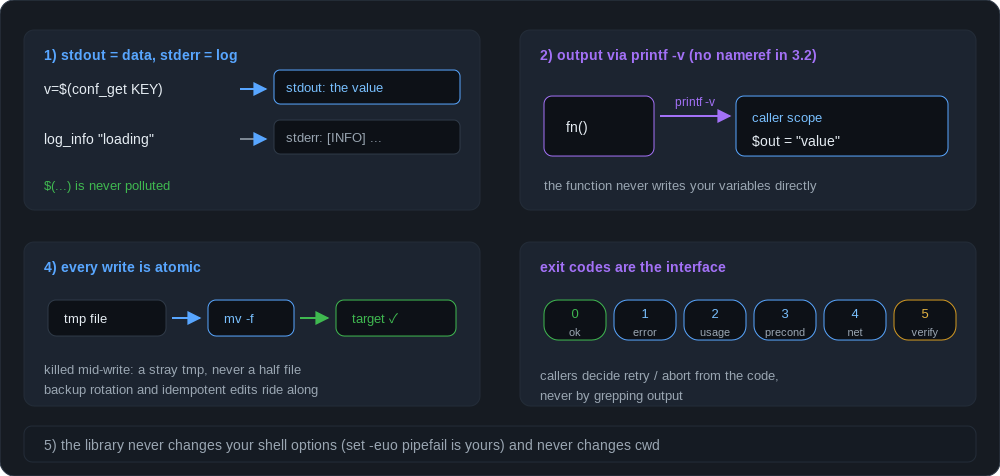
1. stdout carries data only; logs always go to stderr
# Right: the function output is capturable, logs do not interfere
port=$(conf_get_any PORT 8080)
log_info "using port $port"
If log_info also wrote to stdout, $(...) would capture [INFO] using port 8080, so $port would become [INFO] using port 8080, and every later use of it -- building a URL, opening a socket -- fails, with the error surfacing somewhere completely unrelated.
Where this lands in the library: every log_* writes to >&2. It is also why shellkit update --check can print a single version number and nothing else.
2. Out-parameters use printf -v; a function never assigns into the caller's variables
Bash 3.2 has no nameref (local -n arrived in 4.3), so there are only two reliable ways to return more than one value: print to stdout and let the caller capture it, or let the caller name the destination. The library uses the second:
# the caller decides where the result lands
split_host_port() {
  local __target=$1 __outvar=$2 __host __port
  __host=${__target%%:*}
  __port=${__target##*:}
  printf -v "$__outvar" '%s %s' "$__host" "$__port"
}

split_host_port db.example.com:5432 parsed
log_info "parsed: $parsed"
Why not a "global variable by convention": two concurrent calls would overwrite each other. With printf -v the variable name comes from the caller, so scoping is correct by construction.
One trap to avoid: printf -v assigns to the nearest scope that declares that name. If the out-parameter name happens to match one of the library's own locals, the value is written into that inner scope -- your variable keeps the old value, and nothing fails. The library therefore keeps a reserved list of every local on the out-parameter path; calling with one of those names returns exit code 2 instead of failing silently. Names outside the list work as usual, __ prefix or not.
3. Precedence: explicit argument > environment variable > config file > default
conf_init ./config || exit $?

# PORT from the environment > PORT in the config file > 8080
port=$(conf_get_any PORT 8080)
This is implemented exactly once, inside conf_get_any. Reimplementing it per script means some script forgets to look at the environment, so PORT=9090 ./deploy.sh silently does nothing for it -- and that kind of inconsistency is very hard to test for.
conf_get reads the config file only; conf_get_any adds the environment. If you want "ignore the config file, always use this value", use conf_get with your own default.
4. File writes are always atomic
# Interrupting it cannot leave half a file: temp file + mv -f
fs_atomic_write /etc/app/conf "$content" 600

# Backups sort by name and keep the newest five; two runs in the same second do not clobber each other
fs_backup /etc/app/conf 5
A > redirect interrupted halfway leaves a syntactically broken config. The next start reads it and the error usually points at the file contents rather than at "the last write was interrupted". Temp file + mv -f is an atomic replace on the same filesystem.
The fs_ensure_* family writes atomically too and preserves the original mode with cp -p. Plain echo >> on a mode-600 file turns it into 644 -- the most common "I only changed a setting and the key file became world-readable" incident there is.
5. The library never changes the caller's shell options or working directory
set -euo pipefail is enabled by your entry script, not by the library. Once a library is sourced it shares the shell, so if it ran set -e itself, every deliberate grep -q x || true in the caller would start behaving differently.
Likewise the library never cds. Functions that need another directory do it in a subshell:
# inside the library: parentheses = subshell, the cwd change cannot leak
( cd "$dir" && tar -czf "$out" . )
So you can safely enable set -euo pipefail in your entry point. The library will not switch it off, and adds no other global side effects.
One interaction with pipefail deserves spelling out: it changes what a pipeline means. grep -q exits as soon as it matches while the producer is still writing, so the producer is killed by SIGPIPE (exit code 141). That is invisible in normal use -- 141 only shows up in PIPESTATUS -- but pipefail makes the whole pipeline fail with 141, so "found it" turns into "it failed". The library therefore never writes a pipeline whose consumer exits early while the producer may emit more than one line:
# Dangerous: grep -q exits on the first match, the producer may be killed by SIGPIPE (141)
man_modules | grep -qx "$name"

# Safe: let the consumer read the whole input
man_modules | grep -x "$name" >/dev/null
Before you enable pipefail in your own script, check it the same way: when the cmd in cmd | grep -q may print more than one line, use grep -q pattern file instead, or let grep read everything.
Two related practices
- Fail with the documented exit code, never a blanket
exit 1. See the exit-code table in Troubleshooting. - Leave a way back when you delete something.
shellkit uninstall-selfdepends on MANIFEST, andfs_ensure_symlinknever overwrites a regular file. Same idea both times: do not guess when unsure.