
Module map
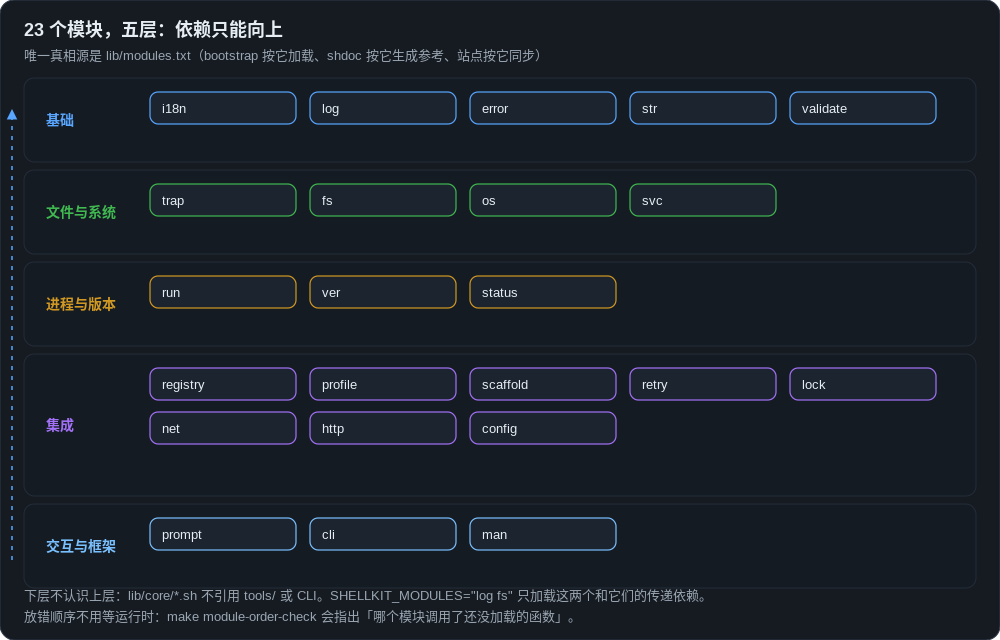
lib/bootstrap.sh is the single entry point. It loads all 27 modules once, in topological order. You do not pick and choose what to source, and you should not copy one module's implementation into your own script -- that is just another way of hitting the same trap twice.
The table
| Module | Responsibility | Key functions |
|---|---|---|
| error | failure and preconditions | die fail require_cmd require_root require_file require_bash |
| i18n | translation lookup | _t _tn |
| log | everything to stderr | log_info log_ok log_warn log_error log_debug log_section |
| str | string ops 3.2 lacks | str_trim str_lower str_upper str_contains str_starts_with str_ends_with str_repeat |
| validate | input validation | validate_not_empty validate_single_line validate_key validate_port validate_ip validate_version validate_abs_path validate_url validate_enum |
| fs | atomic writes, idempotent edits | fs_atomic_write fs_backup fs_ensure_dir fs_ensure_line fs_ensure_block fs_ensure_symlink fs_tmp_init |
| os | the only place for platform differences | os_name os_arch os_is_root os_has_cmd os_pkg_install os_sed_i os_md5 os_sha256 |
| svc | service management (systemd verbs) | svc_start svc_stop svc_restart svc_is_active svc_is_enabled svc_install_unit |
| ver | version comparison (pure bash, segmented) | ver_cmp ver_gt ver_lt ver_eq |
| status | machine-readable status contract | status_emit status_version status_extra status_is_machine status_state_valid |
| registry | manifest registry | registry_add registry_scan registry_get registry_list registry_deps registry_topo |
| profile | profile file primitives | profile_write profile_append profile_parse profile_env |
| trap | the cleanup stack | trap_push trap_pop trap_cleanup trap_install trap_list |
| run | run a command | run |
| retry | retries with backoff | retry |
| lock | single instance | lock_acquire lock_release lock_held |
| net | downloads and readiness probes | net_download net_verify net_sha256 net_wait_port net_wait_http |
| http | sending HTTP requests | net_request net_json net_escape_json |
| config | KEY=VALUE and dotenv configuration | conf_init conf_get conf_get_any conf_has conf_set conf_unset conf_disable conf_keys conf_load_dotenv conf_source |
| scaffold | template variables, manifests, hooks | scaffold_vars_set scaffold_vars_get scaffold_config_load scaffold_render scaffold_manifest_read scaffold_run_hook |
| prompt | interaction | ask ask_yn ask_choice confirm |
| cli | registered-command framework | cli_group cli_cmd cli_run cli_opt cli_opts cli_has cli_usage_global |
| man | man page generation | man_page man_module_page man_write_all man_modules man_count_functions |
| vendor | where the library copy lives | vendor_dir vendor_dir_rel vendor_dir_source vendor_dir_detect |
| proc | process groups and watchdog | proc_start proc_stop proc_is_running proc_watchdog |
| git | the right way to do git | git_default_branch git_is_dirty git_tag git_fetch git_fast_forward git_reset_hard git_worktree_add |
Load order is not alphabetical
Topological order exists because later modules call earlier ones. log needs _t (so i18n loads first), error needs log_error, and cli needs both log_error and _t.
That order lives in one file -- lib/modules.txt, with two columns:
i18n
log          i18n
error        i18n log
str          error
The first column is the module name, the second lists its direct dependencies (space separated, optional). lib/bootstrap.sh loads from it, tools/shdoc.sh generates the API reference from it, the site syncs from it -- adding a module means editing one file, with no second place to forget.
Dependencies must come first. Getting the order wrong does not have to wait for runtime to surface: make module-order-check names the offending call directly.
Load only what you need
By default everything loads (27 modules). To slim it down:
SHELLKIT_MODULES="log fs" . ./vendor/shellkit/lib/bootstrap.sh
Only the listed modules are loaded, and their transitive dependencies come along automatically (i18n is always loaded, because every module needs translations).
Pick a module by task
| What you are doing now | What to use |
|---|---|
| emit a log line | log_info / log_ok / log_warn / log_error / log_debug / log_section |
| fail with an exit code | die / fail / require_cmd / require_root / require_file |
| read configuration (environment wins) | conf_init then conf_get_any |
| change configuration idempotently | conf_set; for any file, fs_ensure_line / fs_ensure_block |
| write a file without corrupting it | fs_atomic_write; back up with fs_backup |
| download and verify | net_download URL DEST [SHA256]; mirror fallback is built in |
| wait for a port / for HTTP | net_wait_port / net_wait_http |
| run a command, stop on failure | run systemctl restart nginx |
| run a command, judge success yourself | run --no-die systemctl is-active nginx |
| retry a few times | retry 5 curl -fsS "$url" -o x |
| guarantee a single instance | lock_acquire deploy 30 |
| always clean up on exit | trap_push 'rm -rf "$workdir"' + trap_install |
| ask the user something | ask / ask_yn / ask_choice / confirm |
| add a subcommand | register with cli_cmd, implement cmd_<name> |
| output in several languages | _t 'english msgid', translations in locale/ |
Boundaries that are easy to get wrong
rundies on failure by default, and theexitinsidedieignores the caller'sif/||. To test success inside a condition, userun --no-die, which only returns the exit code.retrydoes not retry usage errors (SK_USAGE) or verification failures (SK_VERIFY). Retrying those a hundred times gives the same answer.lock_acquirepushes the release onto the cleanup stack as soon as it takes the lock, so you never writetrap 'lock_release'by hand.conf_getreads the config file only;conf_get_anyis the environment-first one. The names differ slightly, the behaviour differs a lot.